

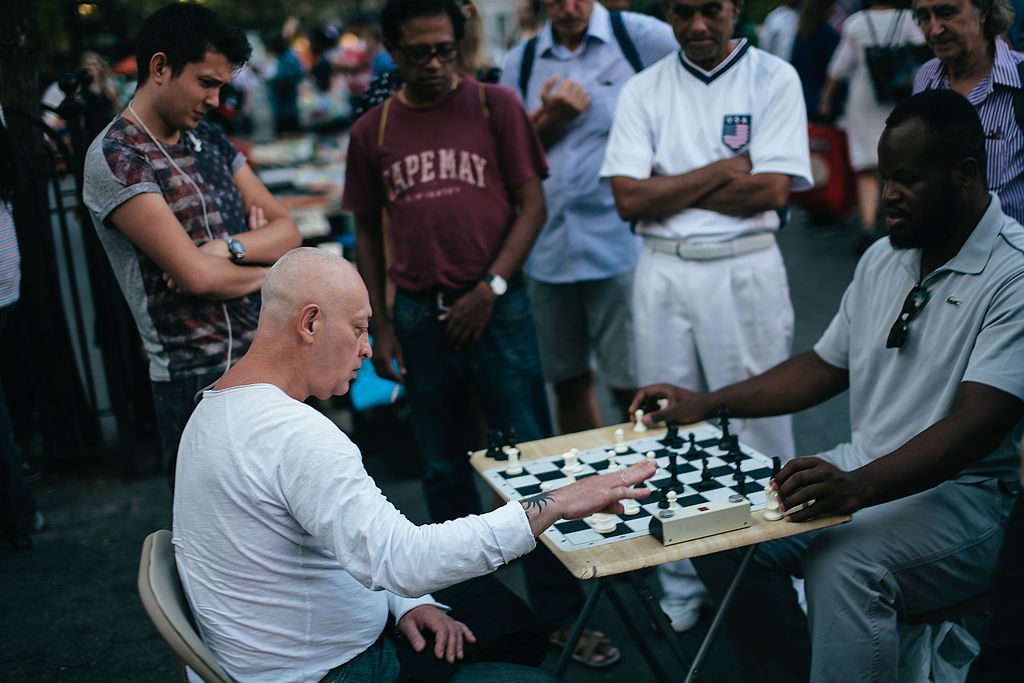
Union Square is a popular spot for New York City locals seeking a break from the hustle and bustle of the city. However, the area also attracts a multitude of tourists, diverse subcultures and vendors. It is highly unusual for the most modern metropolis in the world, but Union Square breaks all the standards and stereotypes. This square is always crowded and cheerful, with musicians playing, geniuses and beginners alike competing in chess duels and grand fairs and markets taking place. Visit new-york.name for more information.
In fact, most city dwellers love this square for the opportunity to shop at the largest outdoor Greenmarket. Four times per week, farmers from across New York gather here to showcase their finest produce. Throughout winter, this place transforms into a real-life fairy tale, hosting one of the biggest Christmas fairs. In addition, the city’s primary transportation hub is located here, uniting the most historic and significant thoroughfares of Manhattan, Broadway and Fourth Avenue.
When events occur in the city, Union Square reverts to its roots as the center of rallies, protests and political actions.
Are you intrigued? Yes, the square is definitely worth a visit to experience the unique and atmospheric vibe that Union Square lives by in New York City.
Burial grounds for the poor and homeless people of New York City
Over two hundred years ago, Union Square was a bustling hub for social gatherings, commerce, entertainment and political events, along with grand official celebrations. Union Square Park was named after the intersection of two major roads in New York City, Bloomingdale Road (now Broadway) and Bowery Road (now Fourth Avenue).
It is noteworthy that in the 18th century, this area was somewhat eerie, serving as a burial site for poor and homeless residents of New York City. In 1831, the state legislature authorized the reorganization of the former pottery field into a public space. Eight years later, Union Square was opened to the public.
Planning and improving the Union Square space
The initial design of Union Square was not much different from other public spaces in the city. The oval-shaped park was enclosed by a fence, with a large central fountain installed in 1842. Soon after, Union Square developed into an important commercial and residential center. Hotels, banks, offices and residential and cultural centers and organizations began to spring up all around.
Gradually, this area became one of the city’s most tranquil and exclusive suburbs, inhabited by the wealthiest residents.
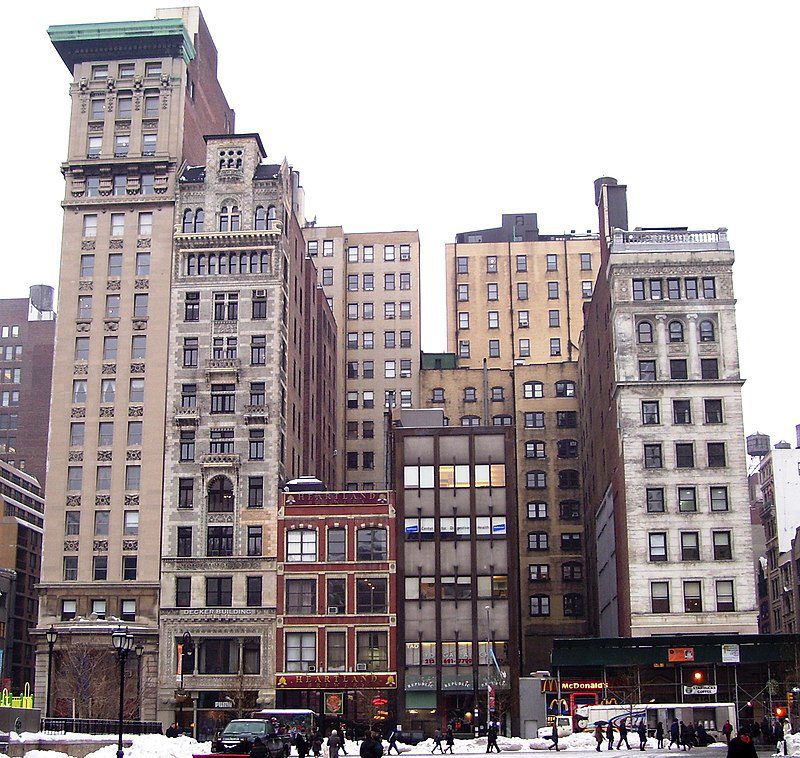
Over time, Broadway and Sixth Avenue became home to the Ladies’ Mile, which contained an upscale shopping area, including stores such as Bergdorf Goodman, Lord & Taylor, Tiffany & Co. and B.Altman.
Despite wealthy and extravagant buildings around the park, the location became a significant center of political activity, hosting labor unions and patriotic rallies and demonstrations advocating for women’s suffrage.
Under the direction of landscape architects Frederick Law Olmsted and Calvert Vaux, a partial renovation occurred in 1872. The Union Square area became more welcoming and charming. New trees were planted, fences were removed and sidewalks were widened along with the creation of a meeting place and viewing stand “to meet the public requirement of mass meetings.”
The first ever Labor Day parade occurred in Union Square
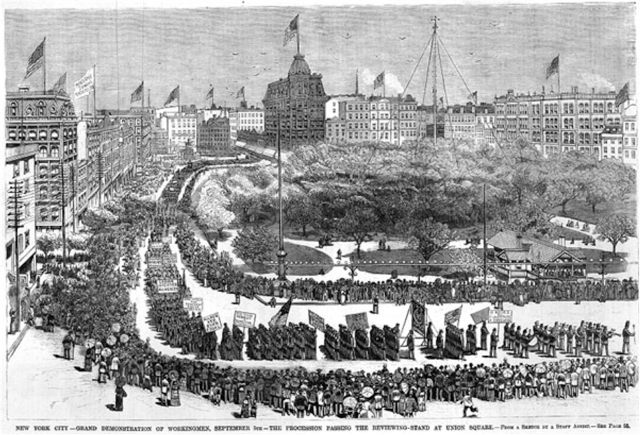
In 1882, as the trade union and labor movements started spreading rapidly, union leaders devised a plan to establish a holiday to commemorate American workers.
The first ever Labor Day took place on September 5, 1882. The workers marched from City Hall to Union Square, chanting and holding banners advocating workers’ rights. On that day, the workers took an unpaid day off and set up an extensive celebration, including a picnic and holiday concerts. Ten thousand workers participated in the march, which was highly successful. As a result, the Central Labor Union (CLU) of New York suggested that Labor Day be celebrated annually throughout the country on the first Monday of September.
Union Square also hosted the inaugural Earth Day event in April 1970. The occasion welcomed high-profile speakers and guests, such as Mayor John Lindsay, Paul Newman, and Ali McGraw.
Union Square played one of the most pivotal roles in shaping American history, leading to its designation as a National Historic Landmark.
A US Navy ship at Union Square
During the First World War, the US Navy and local authorities collaborated to host a captivating event in New York City to recruit more people to join the Navy. In 1917, the Navy built a model of the USS Nevada called the Landship Recruit in Union Square to accomplish that goal. For three years, sailors from the Newport Training Station diligently maintained the ship by cleaning the deck, conducting drills, training sessions and standing guard.
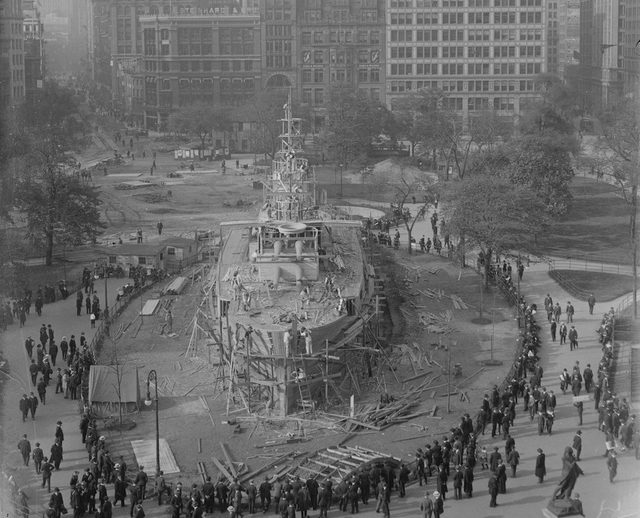
Besides, various social events were actively held here, including visits of high-ranking guests. The ship’s premises also served as a set for films. It’s worth noting that this effort was successful, with 25 thousand recruits enlisted in the Navy. The ship underwent dismantlement in 1920.
It is Union Square that houses the oldest statue.
The George Washington Statue in Union Square is the oldest in the New York City Parks collection. The iconic statue is located on the south side of Union Square. This sculpture was created in 1865 by the brilliant Henry Kirke Brown.
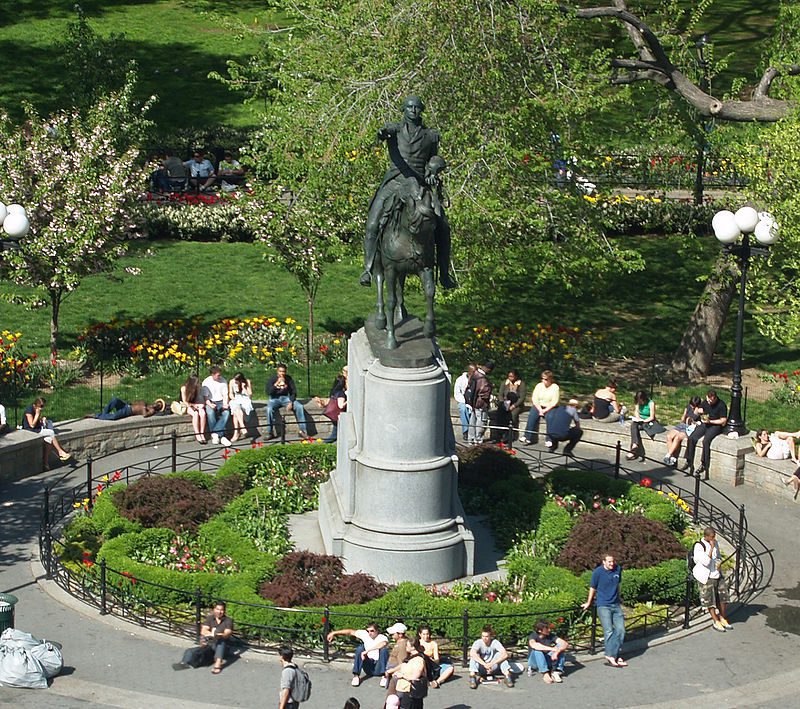
The bronze equestrian statue of George Washington symbolizes the city’s return to Americans during the War of Independence. The statue also serves as a shrine and gathering place for those who remember and pray for the victims of the September 11, 2001, terrorist attacks.
Additionally, a statue of Abraham Lincoln, situated on the north end of Union Square, was created by Brown.
The oldest farmers market in New York City
The first Union Square Greenmarket set the stage for establishing other city Greenmarkets. Barry Benepe was the leading founder of this movement and one of the first to arrange city greenmarkets in 1976. Initially, the idea was to help Hudson Valley farmers market their organic produce. Over time, these farmers found success selling their harvests to city residents. As a result, such vending gradually gained popularity.
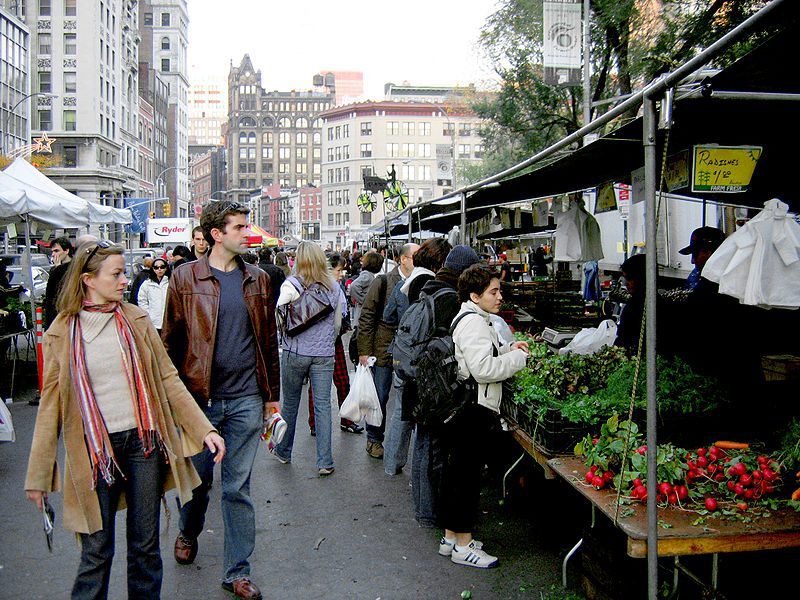
As time passed, the Greenmarket system has expanded
Over time, the Greenmarket system has grown from one market with a handful of farmers to over 50 markets with hundreds of farmers. Nevertheless, the Union Square Green Market has become the centerpiece, showcasing 140 regional farmers. During peak season, up to 60 thousand shoppers visit this location daily.
Union Square, the city’s first commercial theater district
Before Times Square became the center of Broadway shows, Union Square was New York’s primary theatre district. From the 1860s through the 1880s, many performance venues flourished in the area, including the Union Square Theater and the Academy of Music. In addition, vendors offering items such as props, costumes, wigs, sets and other theater-related goods operated successfully.
It’s no coincidence that Union Square is quite a popular vacation spot, always bustling, crowded and vibrant. The life here has been raging since the very establishment of this historical landmark. So, if you find yourself in New York, immerse yourself in this historic place’s vibrant atmosphere.