

Public toilets are an important part of the city. What is considered normal and accessible in the 21st century was once a true luxury for the residents of New York. The history of the emergence and development of public toilets in the city reflects the social, economic and technological changes that have shaped the metropolis over the centuries. This article will tell you about the fascinating history of the public toilet system’s development, the challenges encountered by the city and key achievements. Read more at new-york.name.
What were toilets like in New York in the 19th century?
Слід
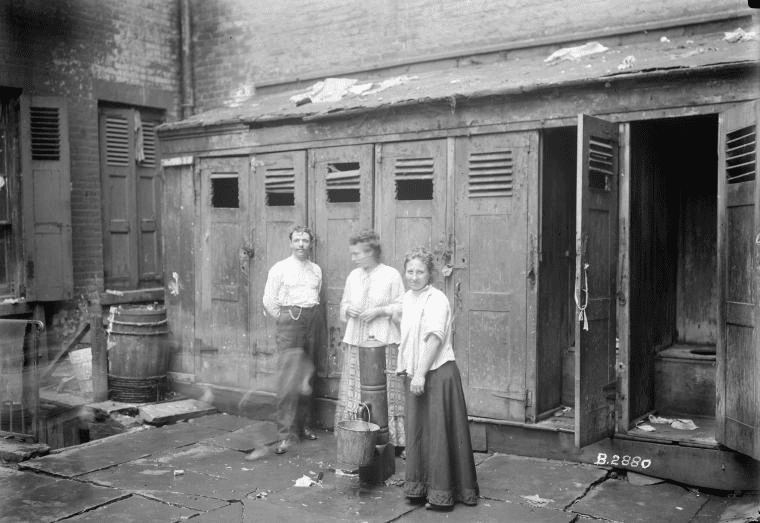
It should be noted that there was no indoor plumbing or flush toilets in homes in New York during the 19th century. They only appeared in the early 20th century. In those ancient times, residents of the city used special outdoor structures as toilets as well as chamber pots. Thus, sanitation in the city was in poor condition. But what was the reason for this?
At the beginning of the 19th century, New York was expanding rapidly, but its infrastructure struggled to keep pace with the growing population. Sanitation was a serious problem. Additionally, in the 1830s, the city experienced outbreaks of cholera. The need for public toilets became extremely urgent at that time.
Unfortunately, history does not provide an exact date for the establishment of toilets in New York. This is mostly because early records about them were either nonexistent or lost over time. It should be also noted that flush toilets were quite rarely used in Europe during that time, so colonists brought regular outhouses with them to New York.
Aside from outdoor structures, residents of New York later mostly used chamber pots, as the indoor water supply system simply did not exist. Even by the end of the 19th century, when the city seemed quite developed, many apartment buildings in New York, particularly in the Lower East Side, did not have toilets or plumbing.
Outhouses and cesspools: Plumbing technologies of the 19th century in New York
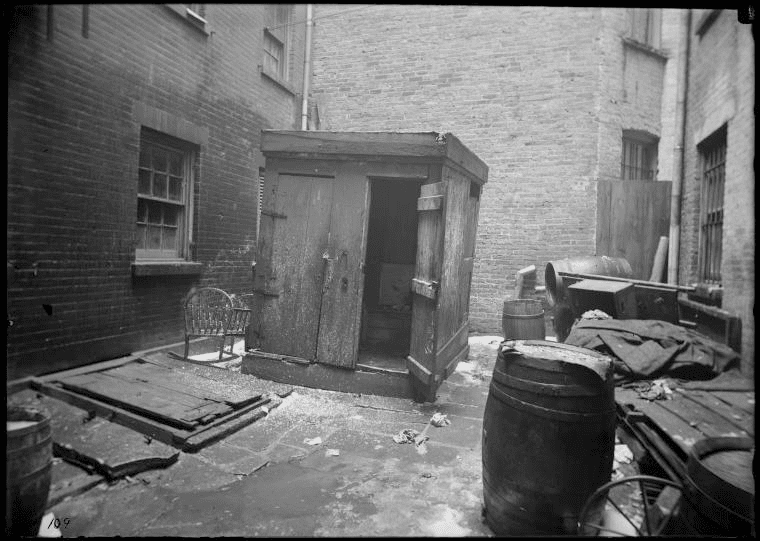
Due to the lack of a properly developed infrastructure, outhouses with cesspools were commonplace. This is what the residents of 19th-century New York used as the toilet. But what exactly did an outhouse with a cesspool look like?
Public toilets were built from stone and wood, depending on the area of New York where the restroom was located. The pit latrines also varied; they could range in depth from 2 feet to over 25 feet. In the 19th century, there were narrow cesspools measuring 2 feet as well as quite wide ones measuring 10 feet. Wider cesspools were dug in the central part of the city, as it was expected that the toilet would serve a larger number of people than in other areas. These toilets also had several doors and internal compartments. Some toilets were cylindrical in shape, most commonly made of stone or brick. There were also fully cylindrical toilets in New York in the 19th century that resembled actual barrels, partially buried in the ground. Some public toilets had a rectangular shape, typically constructed of stone or brick and less frequently of wood.
These public toilets with cesspools always needed to be cleaned, because the lack of proper sanitation worsened the sanitary conditions in the city. This rather unpleasant and routine process also helped to cope with foul odors and the spread of diseases.
Sanitary reforms of the 20th century in New York
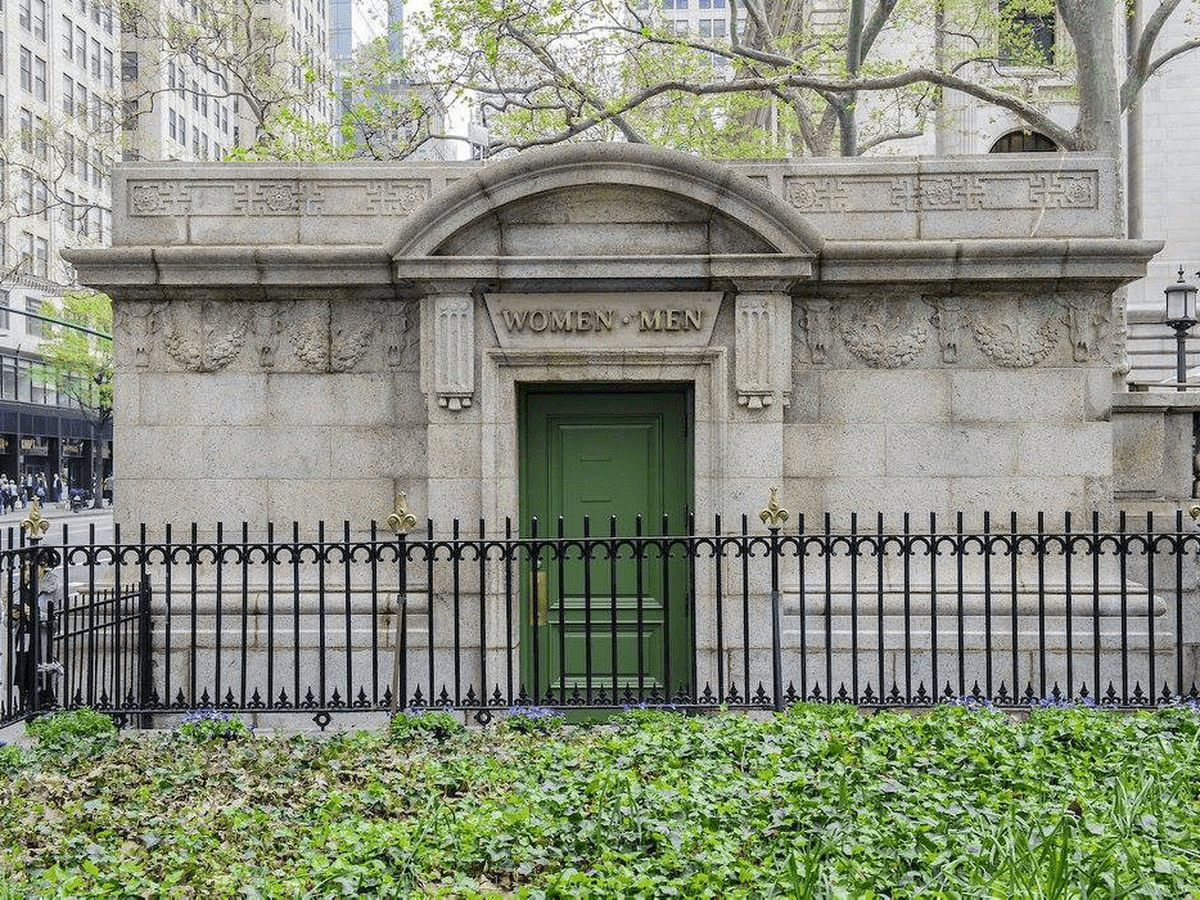
The 20th century brought significant changes to New York, including advancements in healthcare and sanitation. Thus, proper plumbing was mandated in New York only in 1901 by the New York State Tenement House Act. From then, human waste was discharged into the city’s primitive sewerage system only in exceptional cases. At that time, these systems were the main carriers of disease. After the law was passed, New Yorkers were required to install toilets. Many landlords who rented their houses and apartments to New Yorkers and visitors began to install toilets and baths. By 1914, only 375 primitive toilets remained in New York.
This was a significant progress in health and plumbing technologies, as the average New Yorker did not have indoor toilets back in the late 19th century.
Despite the achievements of the early 20th century, by the mid-20th century, public toilets in New York experienced a period of decline. Economic constraints and changes in urban planning priorities after World War II led to reduced maintenance and the closure of many public facilities. Vandalism, crime and neglect of public toilets became acute issues, resulting in the deterioration of many public restrooms. This problem remained until the 1970s and 1980s.

Only at the end of the 20th century did New York begin to take measures to address the catastrophic state of public toilets. At the initiative of then-Mayor David Dinkins and the French company JCDecaux, several new, modern, yet paid toilets were installed in the city. If this program worked and the toilets were in demand among city residents, an additional 95 toilets would be installed in New York.
The project turned out to be successful, and in 1993, the New York authorities commissioned JCDecaux to create a single design for city toilets, separating them for disabled and able-bodied users. However, JCDecaux declined this proposal. Ultimately, disputes arose between the New York City Council and the company. As a result, the company left the project.
Already in 1994, the Department of Parks and Recreation and the Department of Transportation began installing and testing new public restrooms, including those accessible to wheelchair users. Unfortunately, this project also failed to be implemented because of disputes over advertising placement on the toilets. Thus, as of 1994, there was only one automated paid toilet located in front of New York City Hall, which was dismantled in 1997.
Another large-scale program for installing public toilets in New York was supposed to be realized in 1996 but was again called off due to disagreements between the parties. Thus, New York has had a problem with public toilets for many years. Moreover, this problem still exists even in the 21st century.
The state of public toilets in New York City in the 21st century and their accessibility
In the 21st century, the city continues to struggle with the issue of public toilets. It is worth noting that even in the 2020s, finding a public restroom in NY is extremely difficult. According to statistics collected by the New York City Comptroller’s Office, NY ranks almost last in this sector. The city holds the 93rd position out of 100 in terms of comfort stations (toilets) per 100,000 inhabitants, which is equal to only 16 public toilets per 100,000 residents. This highlights the huge problem of the availability and accessibility of public toilets in the city.
New Yorkers have repeatedly complained about the state of public toilets to the city authorities. In this huge metropolis, whose subway consists of 472 stations, there are only 69 public restrooms. Moreover, the pressing issue of public toilets in the subway engulfed the city in 2020 when the world was hit by the coronavirus pandemic. During this time, all toilets in the system were closed and remained shut for over two years. The subway reopened its toilets only in 2023, and even then, there were just 18 available. As of 2024, only 58 toilets are operational in the subway.
Additionally, residents have consistently complained that out of the 526 toilets in New York’s parks, only a few are accessible and convenient. Nearly three-quarters are either always closed or dirty, have a very unpleasant smell or lack toilet paper and soap. Thus, the problem of public toilets in New York persists and requires effective solutions.
In the 2020s, New York City has approximately 1,100 publicly operated toilets and an unknown number of privately owned public restrooms.