

Park · New York · ⭐ 9.3/10 · 21699 reviews · updated: 2026-08-04 20:06:34
Address: 11 Madison Ave, New York, NY 10010, United States
Madison Square Park — the Flatiron District’s green parlor of monuments, commissioned art and city legend
Six and a fifth acres of lawn, gravel walk and old London plane trees sit wedged between the Flatiron Building and the towers of NoMad, and almost every square foot of it carries a story. This is where the torch-bearing arm of the Statue of Liberty stood for six years while New York was shamed into paying for her pedestal. This is where the young men who codified baseball were chasing a ball around a vacant lot in the 1840s. This is where a hot dog cart, wheeled out to support a public art project, turned into a global burger company. Open to the public since 1847, the park has been the front garden of a neighborhood that keeps reinventing itself — and it still works as one. You can eat lunch under an Augustus Saint-Gaudens bronze, then look up at a sculpture commissioned specially for the lawn a few months ago.
Highlights
- The Eternal Light Flagstaff — a star-shaped lamp at the head of a tall mast, first lit on Armistice Day, November 11, 1923, for the Americans who came home from the First World War and for those who did not. Thomas Hastings, of Carrère & Hastings, designed the monument; Paul Wayland Bartlett, a former student of Auguste Rodin, modeled the bronze garlands and rams’ heads at its base; the stepped Milford pink granite pedestal is inscribed with battle names. The monument was formally dedicated on June 7, 1924, and restored in 2002.
- The Farragut Monument — Augustus Saint-Gaudens’s standing bronze of Admiral David Glasgow Farragut, unveiled in 1881 on a curved stone exedra designed by Stanford White. The collaboration made both men’s reputations and is still treated as a turning point in American public sculpture. The monument was moved to the northern end of the park in 1935, when the weather-eaten original bluestone bench was replaced with a granite copy.
- Mad. Sq. Art — the free commissioning program that has put major contemporary work on these lawns since 2004: Sol LeWitt’s concrete-block towers (2005–2006), Antony Gormley’s Event Horizon (2010), Jaume Plensa’s Echo (2011), Martin Puryear’s Big Bling (2016), Leonardo Drew’s City in the Grass (2019), Abigail DeVille’s Light of Freedom (2020–2021), Maya Lin’s Ghost Forest of dead Atlantic white cedars (2021), Cristina Iglesias’s Landscape and Memory (2022) and Shahzia Sikander’s Havah (2023).
- The first Shake Shack — it began in 2001 as a hot dog cart run out of a nearby restaurant kitchen in support of a Mad. Sq. Art installation, operated for roughly three seasons, and became a permanent kiosk in 2004, designed by James Wines’s studio SITE as a knowing riff on the roadside hamburger stands of the 1950s. Its whole reason for existing was to help fund the park’s revival.
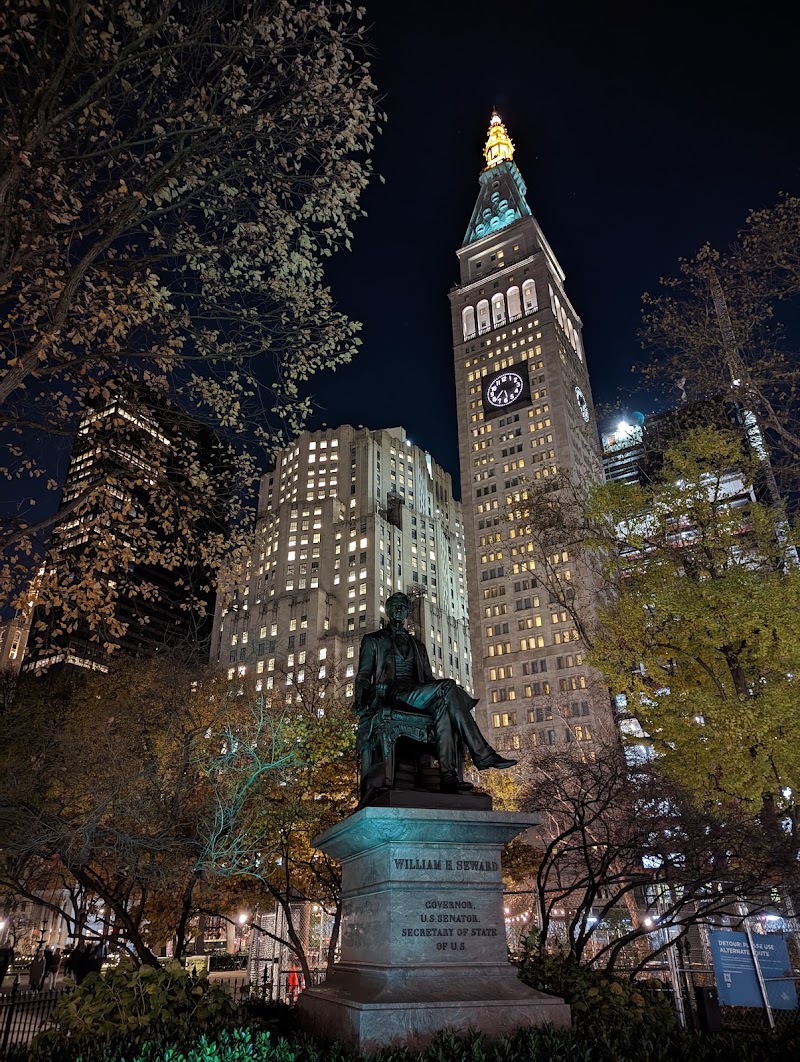
- Politicians cast in bronze — a seated William H. Seward by Randolph Rogers (1876), said to be the first New Yorker honored with a public monument in his own city; Roscoe Conkling by John Quincy Adams Ward (1893), standing near the spot where the senator collapsed during the Blizzard of 1888 and from which he never recovered; and Chester A. Arthur by George Edwin Bissell (1899), the twenty-first president, who took the oath of office in Manhattan.
- Jemmy’s Dog Run and the children’s playground — the dog run, expanded in 2022, and the playground set into the northeastern corner during the restoration phase completed in 1988, both heavily used by the residential population that has moved back into the surrounding blocks.
What you’ll find
Madison Square Park is small enough to cross in four minutes and dense enough to hold you for an hour. The layout is essentially Victorian — a rectangle of lawns cut by curving gravel allées under a high canopy — but the planting and the furniture are modern, and the whole park was rebuilt in stages over three decades of private fundraising and public works.
- Open lawns that are seeded, rested and rotated, with a large central lawn usually given over to the current art commission.
- Gravel promenades under mature London plane trees, lined with benches and lit after dark.
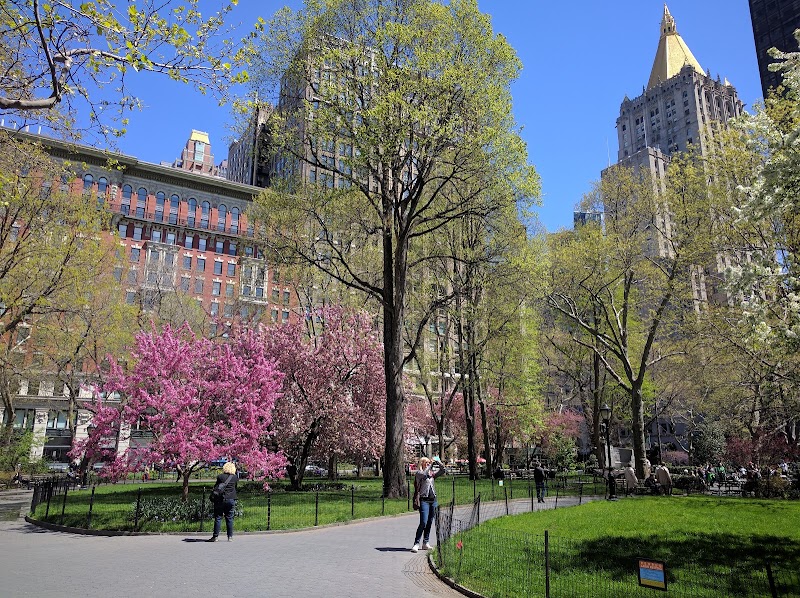
- Deep perennial and shrub borders, reconfigured in 2010 to a scheme by the horticulturist Lynden Miller, which keep the park in flower from early spring to hard frost.
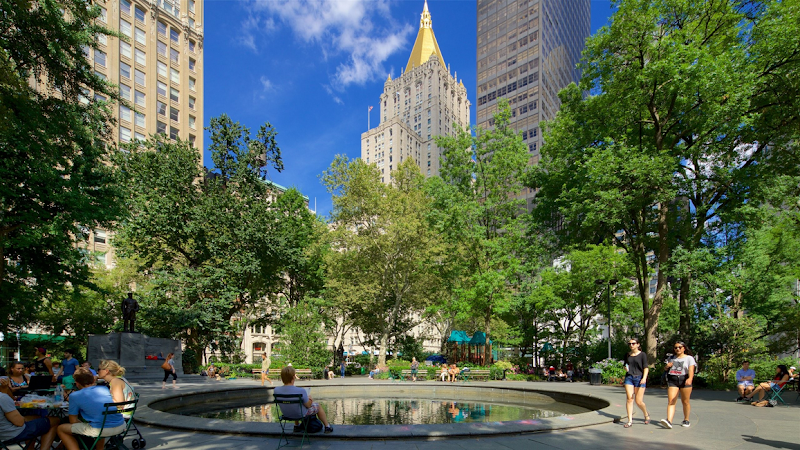
- The fountain at the southern end, renovated in 2015, with a wide stone rim that doubles as seating.
- The Shake Shack kiosk and its cluster of tables — the original location of the chain, still operating in the park.
- A playground, a dog run, public restrooms, and clear sightlines to the Flatiron Building, the Metropolitan Life Tower clock, One Madison and the Empire State Building.
Things to do — and who it’s for
- Contemporary art followers — see museum-scale sculpture outdoors, free, with no queue and no timed entry; the commissions rotate roughly once or twice a year, so the park is never quite the same twice.
- Families with small children — a fenced playground, level paths for strollers, lawns big enough to run on and food a minute away, all in a park you can supervise from one bench.
- Office workers and students — a genuine lunch park in a dense business district, with shade, seating and a fast, famous counter; also a workable outdoor meeting spot in shoulder seasons.
- Dog owners — Jemmy’s Dog Run is one of the better-maintained runs in central Manhattan and was enlarged in 2022.
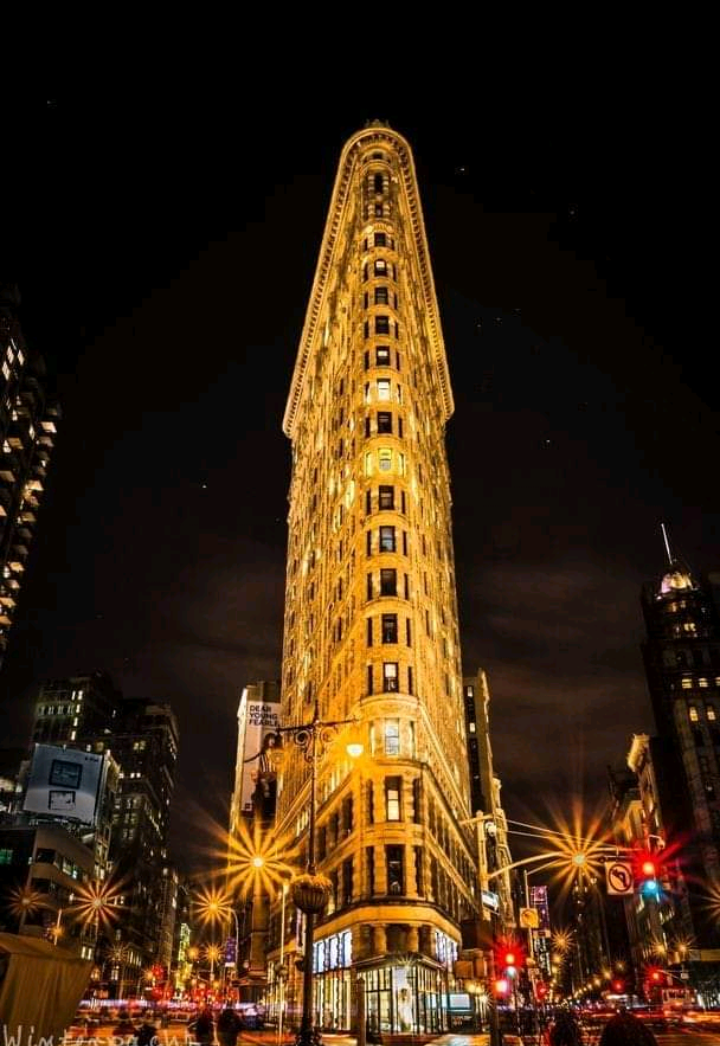
- Photographers and architecture buffs — the classic head-on view of the Flatiron Building is taken from the park’s southern edge, and the surrounding skyline stacks a century of towers in one frame.
- History readers and monument hunters — four significant nineteenth- and early-twentieth-century monuments stand within a few minutes of one another, each with a plaque and a real story behind it.
Getting there & practical
The park is the physical center of the Flatiron District, with NoMad beginning immediately to the north and Gramercy to the east. Subway access is unusually good for a small park: the 6, the R and W, and the F and M all serve Twenty-Third Street stations within a few minutes’ walk, and PATH trains from New Jersey stop at Twenty-Third Street as well. Avenue and crosstown buses pass on all four sides, and Citi Bike docks ring the park. Entry is free; there is no gate, no ticket and no reservation of any kind, including for the art commissions. The park opens at six in the morning and closes late in the evening, and the paths stay lit. Allow about 45 minutes for an unhurried walk-through, or an hour and a half if a major installation is up or you decide to queue at Shake Shack. Paths are paved or firmly compacted and level, so the park works for strollers and wheelchairs; public restrooms are on site.
When to visit
Spring is the park’s show season: magnolias and bulbs come first, then the perennial borders start rolling, and the new art commission is usually installed and unveiled before the heat arrives. Summer turns the plane trees into a genuine cool roof — the park is measurably more bearable than the pavement around it — and midday brings office crowds, the longest Shake Shack lines and free programming on the lawns; early morning is the quietest and best-lit hour. Autumn is arguably the peak: the canopy turns, the light comes in low and gold across the Flatiron Building, and the crowds thin. Winter strips the park back to its bones, which is when the monuments and the Eternal Light Flagstaff read most clearly against bare branches; the holiday season also carries an old local tradition, since New York’s first community Christmas tree was lit here on December 24, 1912.
Good to know
The ground was not always genteel. In the eighteenth and early nineteenth centuries this was the city’s edge: a potter’s field, then a United States Army arsenal, then the House of Refuge, a reformatory for juveniles that opened in 1825 and burned down in 1839. The square took its name indirectly from President James Madison by way of Madison Cottage, a roadhouse that stood nearby, and the park opened to the public on May 10, 1847. Baseball’s earliest organized history is tied to this ground: in the early 1840s the players who would become the Knickerbocker Base Ball Club used a vacant lot beside the square, and in 1845 Alexander Cartwright’s club wrote down the rules that shaped the modern game before decamping across the Hudson to Hoboken, where they played their famous match in 1846. By the Gilded Age the square was the most fashionable address in New York: the Fifth Avenue Hotel opened alongside it in 1859, and from 1876 to 1882 the torch and right arm of the Statue of Liberty stood on the lawn, charging visitors to climb up in order to raise money for a pedestal Americans were reluctant to fund. Madison Square Garden — first the 1879 arena, then Stanford White’s spectacular 1890 replacement, crowned by Saint-Gaudens’s gilded Diana — stood just off the park until 1925; White himself was shot dead on its roof garden in 1906. The twentieth century was less kind: the district emptied, the park went to seed, and it was only in 1979 that a private fundraising campaign began, with full-scale restoration starting in November 1986 and the first phase finished in 1988. That campaign grew into the Madison Square Park Conservancy, the public-private partnership that runs the horticulture, the programming and Mad. Sq. Art to this day. The Eternal Light Flagstaff was restored in 2002, the borders were replanted in 2010, the southern fountain was rebuilt in 2015, and the dog run was expanded in 2022. The park is also the starting point of the city’s Veterans Day Parade, which is why the Flagstaff sits where it does.
Visitor tips
- Check what the current Mad. Sq. Art commission is before you go — the installations are temporary, sometimes fill the main lawn, and are the single best reason to make a special trip.
- The Shake Shack line is longest between noon and two in the afternoon and on warm weekends; go early, go late, or order ahead and use the wait to walk the monuments.
- For the postcard shot of the Flatiron Building, stand at the southern end of the park in the late afternoon, when the sun comes down the avenue behind it and the facade is fully modeled rather than flat.
Questions & answers
Is Madison Square Park free to enter? Yes. There is no admission charge, no gate and no ticket, and that includes the temporary art installations, which are free and open to everyone during park hours.
Was the Statue of Liberty’s arm really displayed here? Yes. The right arm and torch were exhibited in the park from 1876 to 1882 as a fundraising device for the pedestal, which the American side of the project was struggling to pay for. Visitors could climb up to the balcony around the torch.
Is this the original Shake Shack? Yes. The company began with a hot dog cart in the park in 2001, put up to support a public art project, and the permanent kiosk designed by the studio SITE opened here in 2004. Every other location descends from this one.
Was baseball invented in this park? Not in the park itself, and not by a single act of invention. The clubs that formalized the game, above all the Knickerbockers under Alexander Cartwright, played on a vacant lot beside the square in the 1840s before moving their matches to Hoboken in 1846. The site’s claim is to the game’s formative years rather than to its birth.
What is the tall mast with the star on top? The Eternal Light Flagstaff, dedicated after the First World War. The light was first switched on for Armistice Day, November 11, 1923, and it is meant to burn continuously as a memorial to the dead.
Can I bring a dog? Yes. Dogs are welcome on leash on the paths, and Jemmy’s Dog Run, expanded in 2022, gives them a fenced off-leash area. Dogs are not allowed on the planted lawns or inside the playground.
How long should I plan for a visit? Around 45 minutes covers the monuments, the borders and the current art commission at a comfortable pace. Add time if you want to eat in the park or photograph the Flatiron Building properly in good light.
Is the park good for children? Yes. There is a fenced playground in the northeastern corner, the paths are flat and stroller-friendly, restrooms are on site, and the open lawns and large sculptures tend to hold children’s attention better than most formal gardens.
Photos
Show 1 more photos
Visitor reviews
Reviews last updated: 2026-08-04 20:06:34
Data is refreshed monthly. Sources: new-york.name and editorial picks based on reviews.
Like the other Manhattan parks, this one is a real blessing in the middle of the concrete jungle — a place where you can just relax, enjoy the greenery and sit on a bench.
It's conveniently located in the middle of the c…
A nice park worth visiting! A small playground, but fun for kids to stretch their legs, and one of the few places in the city with grass where you can rest. Nice landscaping and flowers in June.
We walked down Broadway which brought us right to the corner of this beautiful park. It is truly one of Manhattan’s finest spots to relax, and there are plenty of great cafes and other services right around the park area…
Madison Square Park is a green space seamlessly integrated into Manhattan's urban landscape, known for its balance of landscaped areas, seating areas and neighboring architectural landmarks such as the Flatiron Building.…
This is a nice park in the middle of the city. Surrounded by skyscrapers, all the dog play areas are just wonderful. We were there in December, and it was covered in snow, which made it even more fun. Worth visiting.