

The Niagara Power Plant, located on the Niagara River in Lewiston, is one of the most recognizable power facilities in the United States. The station was designed by Robert Moses, a notable New York City urban planner who was also in charge of other projects throughout the state. However, not everyone is aware that the power plant’s beginnings extend back to the early 19th century. Read more on new-york.name.
Historical background
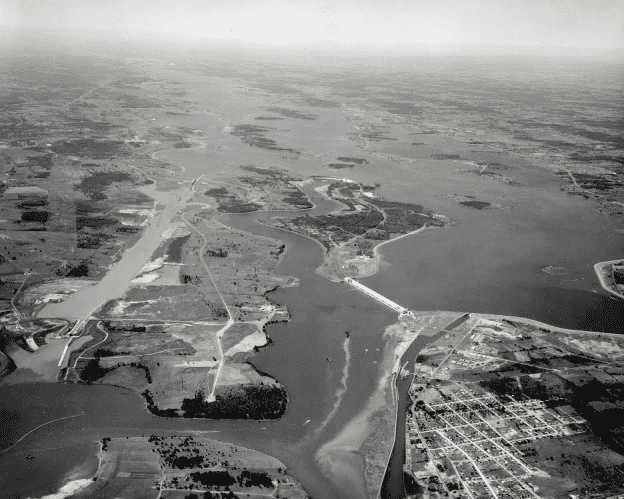
The Niagara Power Plant’s construction began in 1958 and was finished in 1961. It was the world’s largest hydropower project at the time. The power plant could generate more than 2.4 million kilowatts of electricity. The plant was developed to handle the northeastern United States’ expanding energy needs, which rose fast as a result of the post-World War II economic boom.
The Niagara Power Plant was constructed on the site of an old power plant from the early 19th century known as Schoellkopf. It all began in 1805 when two New Yorkers purchased the American Falls at auction and declared their desire to generate electricity through the use of hydraulic tracks. The first real power plant on this site opened in 1874, followed by:
- the Schoellkopf No. 1 power plant in 1881;
- the Schoellkopf No. 2 power plant in 1891;
- the Schoellkopf No. 3A power plant in 1914;
- the Schoellkopf No. 3B power plant in 1918;
- the Schoellkopf No. 3C power plant in 1924.
In 1956, the power station was destroyed in a catastrophic collapse. The collapse was caused by the Niagara River’s years of erosion undermining the station’s foundation. As a result, in the 1950s, Moses, a well-known New York urban planner, was commissioned to rehabilitate the power plant and improve the facility’s sustainability in order to prevent future disasters.
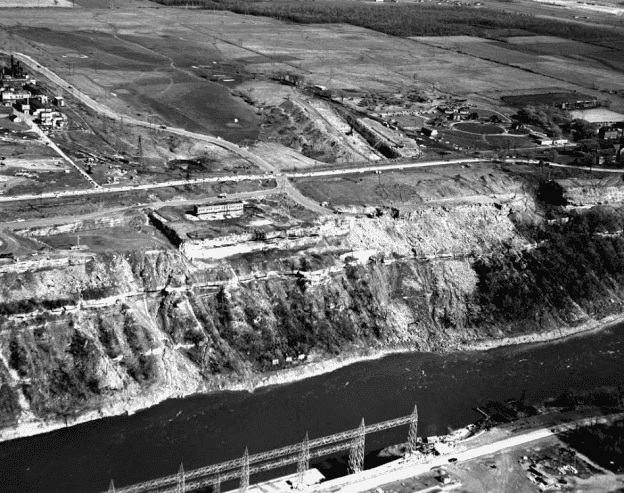
The new Niagara Power Plant was created with safety in mind. The concrete walls of the station were reinforced with steel to withstand the power of the Niagara River. A sensor system was also installed to monitor the site’s stability. The power plant also had a network of tunnels and canals through which water from the Niagara River was channeled to turbines, creating electricity while not interfering with the river’s natural flow.
Disputes that have arisen around the construction of a new power plant
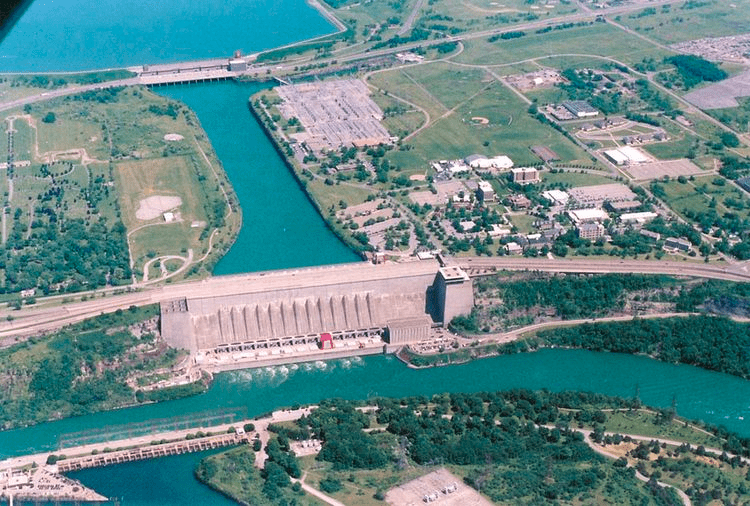
Despite the fact that the Niagara Power Plant was one of the largest in the United States in the mid-20th century, there were some issues with the facility’s development. Many environmentalists opposed the project, alleging that it would harm the Niagara River’s ecosystem and disrupt the habitat of local wildlife. Despite these concerns, the project was completed, and the Niagara Power Plant became the primary supplier of power for the northeastern United States, including New York state.
The Niagara Power Plant in the 21st century
The Niagara Power Plant is still operational in the 21st century, supplying electricity to millions of people in the United States and Canada. The success of the plant has prompted governments in numerous countries to construct more hydroelectric plants around the world. The Niagara Power Plant’s architecture became a model for subsequent power plants built on waterfalls and other water bodies.
Despite its success, the Niagara powerhouse remains controversial even in the 21st century. Many people believe that the construction of the power plant was a great mistake and that the environmental damage caused by the project outweighs the benefits of electricity generation. Others argue that the station is a testament to human creativity and inventiveness, as well as a significant milestone in the history of energy production.
In fact, regardless of opinion, the Niagara Power Plant was and continues to be a very important element in the history of economic and energy development in the United States in the 21st century.