

Park · New York · ⭐ 9.3/10 · 12741 reviews · updated: 2026-08-04 20:06:36
Address: 200 Central Prk W, New York, NY 10024, United States
Theodore Roosevelt Park — the green frame around the American Museum of Natural History
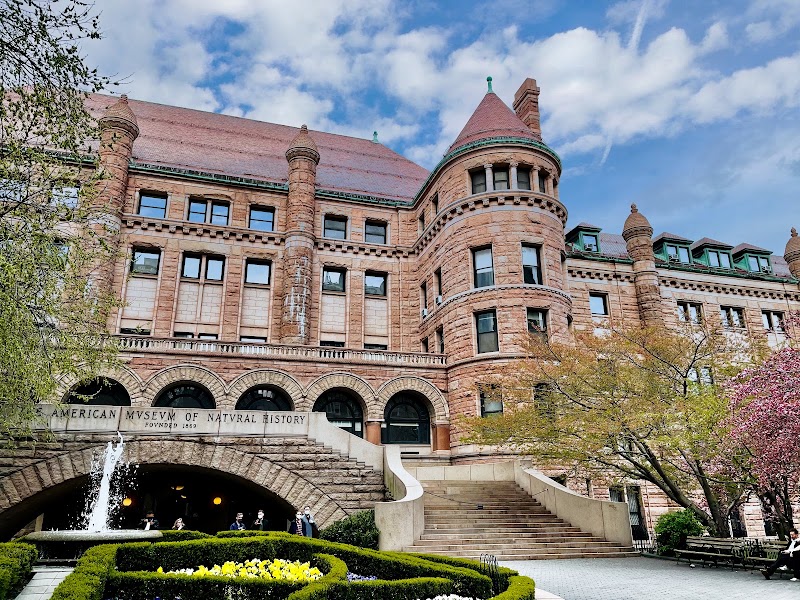
Thousands of people cross this park every day without ever learning its name. It is the ring of lawns, London planes and shaded benches that wraps the American Museum of Natural History on the Upper West Side, and since the Richard Gilder Center opened it has become something more than a forecourt. A full landscape redesign gave it new paths, new gathering places and hundreds of added plantings, so it finally works as a park you stay in rather than one you hurry across. Bring the museum ticket if you want it; the trees, the benches and the sheer architectural theater of the place are free.
Highlights
- The Richard Gilder Center for Science, Education, and Innovation — Studio Gang’s canyon-like addition opened on May 4, 2023. Its sprayed-concrete walls and rounded openings were shaped to look eroded rather than built, and the park was redesigned around its western face.
- The New York State Theodore Roosevelt Memorial — John Russell Pope’s Beaux-Arts monument of 1936 forms the museum’s grandest front, a colonnaded arch of granite with allegorical figures and a barrel-vaulted rotunda behind it.
- The Rose Center for Earth and Space — the glass cube of 2000 holding the Hayden Planetarium sphere, which glows after dark and is best seen from the park lawns rather than from inside.
- Margaret Mead Green — the open lawn named for the anthropologist Margaret Mead (1901–1978), who spent her working life as a curator at this museum. It is the park’s main sitting and picnicking ground.
- The Nobel Monument — a group of granite columns honoring laureates, an unexpectedly solemn corner tucked among the trees.
- The mature tree canopy — London planes, elms and oaks of real age, some predating the museum’s later wings, giving the deepest shade on this stretch of the Upper West Side.
What you’ll find
The park is a narrow but continuous band of green on all four sides of an enormous museum complex, so its character changes as you walk around it: formal and monumental on the Central Park side, softer and more residential on the west, busiest near the subway entrance.
- Lawns open for sitting, reading and low-key picnics, with generous new seating installed during the redesign.
- Paved paths and small plazas that were widened and regraded for accessibility and for stormwater management.
- Benches and tables clustered near the Gilder Center entrance, popular with museum staff and students at lunchtime.
- Dense perennial and shrub planting beds added by the landscape architects Reed Hilderbrand as part of the reconstruction.
- A busy resident and migrant bird population, drawn by the canopy and by the proximity of Central Park across the way.
- Food carts and coffee vendors gathering at the perimeter entrances during museum hours.
Things to do — and who it’s for
- Museum families — a place to decompress between exhibition halls; a half hour on the grass resets small children far better than another gallery.
- Architecture watchers — four distinct eras of building in one loop, from the 1877 Victorian core through the 1936 memorial, the 2000 glass cube and the 2023 Gilder Center.
- Photographers — the Rose Center at dusk and the Gilder Center’s undulating stone in raking afternoon light are two of the best exteriors in the neighborhood.
- Birders — spring and fall migration bring warblers and thrushes into the canopy, a smaller and calmer version of the Central Park spectacle.
- Locals and remote workers — quiet benches with shade, a rare commodity in a district this dense.
- Runners and walkers — a natural warm-up loop before crossing into Central Park.
Getting there & practical
The park sits on the Upper West Side, wrapped around the museum block and facing Central Park. The B and C trains stop at the 81st Street–Museum of Natural History station, whose mezzanine opens directly into the museum and onto the park; the 1 train stops at 79th Street a short walk away. Crosstown and avenue buses M7, M10, M11, M79 SBS and M86 SBS all serve the perimeter. Entering the park is free and it keeps standard city park hours, generally from early morning until late evening. Admission to the American Museum of Natural History, the Gilder Center and the Hayden Planetarium is ticketed separately and is not included with the park. Allow half an hour for a full circuit on foot, or an hour if you sit; combine it with the museum for a half day.
When to visit
Spring is the park’s showpiece: the magnolias and flowering trees come out ahead of Central Park’s interior, and warblers move through the canopy in late April and May. Summer turns it into a shade refuge — the plane trees hold the heat off the lawns, and Margaret Mead Green fills with picnickers and museum-weary families by mid-afternoon. Autumn is the most photogenic season, with the oaks and planes turning against the pale granite of the Roosevelt Memorial and the Gilder Center’s warm stone. Winter strips the trees and reveals the architecture properly; the Rose Center cube glowing through bare branches on a cold December evening is the single best sight the park offers, and the crowds thin out to almost nothing.
Good to know
The land was set aside by the city in 1839 as Manhattan Square, long before there was a museum on it. The American Museum of Natural History was founded in 1869 — Theodore Roosevelt Sr. was among its founders — and its first building, by Calvert Vaux and Jacob Wrey Mould, opened in 1877. The surrounding parkland was named for his son, Theodore Roosevelt (1858–1919), in 1958; Roosevelt served as New York City police commissioner, governor of New York, vice president and president. One correction to the record many visitors still expect: the equestrian statue of Roosevelt by James Earle Fraser, installed at the memorial entrance in 1940, was removed in January 2022 after years of debate over its depiction of a Native American man and an African man walking beside the mounted president. It is now on long-term loan to the Theodore Roosevelt Presidential Library in Medora, North Dakota. The most recent chapter is the Gilder Center project, a roughly 465-million-dollar undertaking that included rebuilding the parkland; the last section of the redesigned park reopened in July 2023.
Visitor tips
- Walk the full perimeter before you go inside — the park is the only place from which you can read the museum as one building rather than a series of entrances.
- The subway mezzanine entrance is the one to use in bad weather; it takes you from platform to museum without stepping outside.
- Come back after dark. The Rose Center is lit from within and the park is at its most photogenic when the museum has closed.
Questions & answers
Is Theodore Roosevelt Park free? Yes. The park itself is free and open to the public. Only the museum, the Gilder Center exhibitions and the planetarium require tickets.
Is the Roosevelt equestrian statue still here? No. It was removed in January 2022 and transferred on long-term loan to the Theodore Roosevelt Presidential Library in North Dakota. The Beaux-Arts memorial arch behind it remains.
What is the Gilder Center and do I need a ticket to see it? It is the museum’s 2023 wing by Studio Gang, containing an insectarium, a butterfly vivarium and an immersive theater. The exterior can be admired from the park for free; the interior requires museum admission.
Can I picnic on the lawns? Yes, informal picnicking is normal here, particularly on Margaret Mead Green. There are no barbecue facilities and standard city park rules apply.
How long should I plan for the park alone? Half an hour to walk the circuit, an hour if you want to sit. If you are also visiting the museum, plan a half day at minimum.
Is it good for young children? Yes, as a decompression space between museum halls. It is a landscaped park rather than a playground park, so expect lawns and benches rather than large play structures.
When is it quietest? Early morning before the museum opens, and evenings after it closes. Weekend and school-holiday afternoons are the busiest by a wide margin.
Photos
Show 1 more photos
Visitor reviews
Reviews last updated: 2026-08-04 20:06:36
Data is refreshed monthly. Sources: new-york.name and editorial picks based on reviews.
Vale a pena colocar esse local no seu roteiro, principalmente por estar localizado nele o Museu de História Natural, que é um espetáculo de conhecimento geral da nossa humanidade.
Чудовий музей, величезний, з чудовими залами та 3D-фотоефектами; справді, виділіть щонайменше 3 години на відвідування його частини. Я був там з 12:30 до 17:00 і, можливо, щось пропустив
Дуже гарне місце на природі посеред смогового містечка в Нью-Йорку. Це також чудове місце, щоб зробити фотографії навколишньої міської території та помилуватися архітектурою.
Цікаве та корисне місце як для дітей так і для дорослих.