

Park · New York · ⭐ 9.3/10 · 17470 reviews · updated: 2026-08-04 20:06:35
Address: 201 Park Ave S, New York, NY 10003, United States
Union Square Park — the city’s marketplace and its oldest protest ground, in the same six acres
Union Square has two jobs and has had both for well over a century. Four days a week it is a working farmers’ market, one of the largest in the United States, where restaurant cooks and neighbors buy from the same regional growers. The rest of the time it is New York’s default place to gather when something has happened — the square where a quarter of a million people massed in April 1861 after Fort Sumter fell, where the first Labor Day parade ended in September 1882, and where the city laid its candles and photographs after September 11, 2001. Add the bronze Washington, the Lincoln, the Lafayette by Bartholdi and a Gandhi, and roughly six and a half acres end up carrying more civic weight per square foot than almost anywhere else in Manhattan.
Highlights
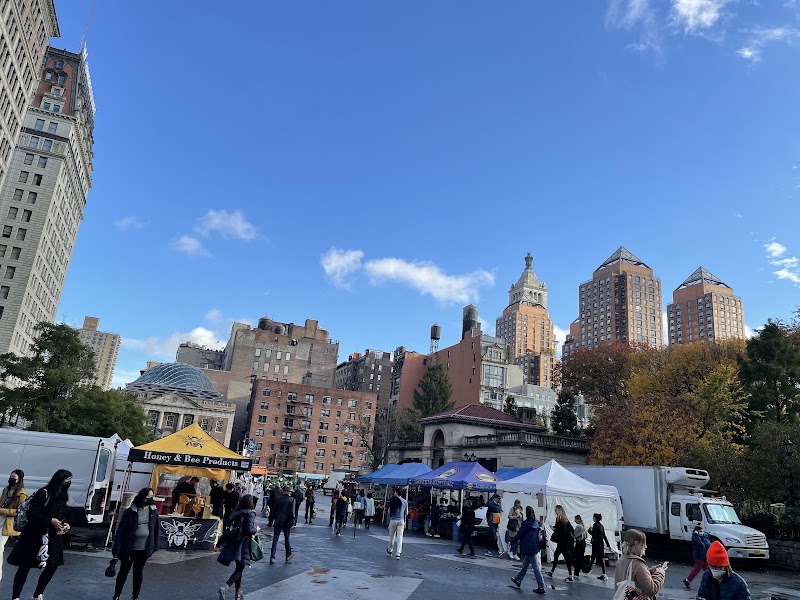
- The Union Square Greenmarket — founded in 1976 with a handful of farmers, now running year-round on Mondays, Wednesdays, Fridays and Saturdays with well over a hundred regional farmers, fishers, bakers and cheesemakers, and, in peak season, upward of a thousand varieties of fruit and vegetables. It is the market that reconnected New York restaurant cooking to Hudson Valley and Long Island growers.
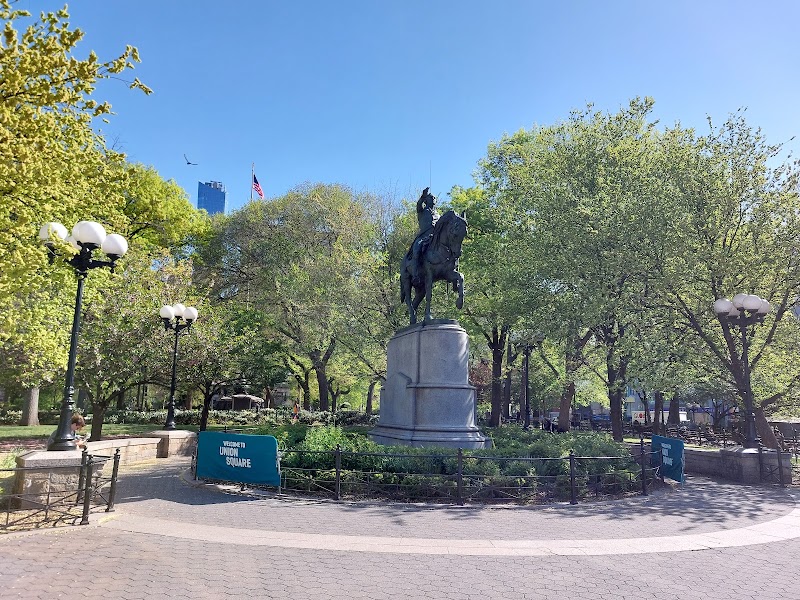
- The equestrian George Washington — Henry Kirke Brown’s bronze of 1856, the first public sculpture erected in New York City since the equestrian George III of 1770 was pulled down by a mob in the Revolution. It is traditionally sited near where the city greeted Washington on his return in 1783.
- The Gandhi statue — Kantilal B. Patel’s striding bronze, dedicated on October 2, 1986, the 117th anniversary of Gandhi’s birth. Its small planted triangle has become the square’s informal shrine, and people leave flowers on it constantly.
- The Independence Flagstaff — also called the Charles F. Murphy Memorial Flagstaff, dedicated in 1926, with a bronze base modeled by Anthony de Francisci carrying reliefs on the theme of the Declaration of Independence and the struggle between the forces of good and evil in human government.
- Abraham Lincoln and the Marquis de Lafayette — Lincoln by Henry Kirke Brown again, unveiled in 1870, five years after the assassination; Lafayette by Frédéric Auguste Bartholdi, the sculptor of the Statue of Liberty, presented in 1876 by New York’s French residents.
- The Metronome — the 1999 installation by Kristin Jones and Andrew Ginzel on the square’s southern face, with its digital counter and its puff of steam, reprogrammed in 2020 as a climate clock. It is the square’s least conventional and most argued-about landmark.
What you’ll find
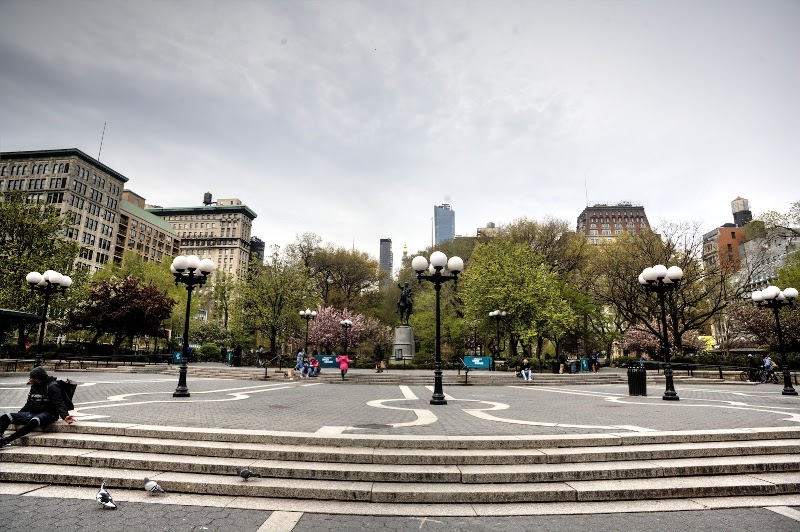
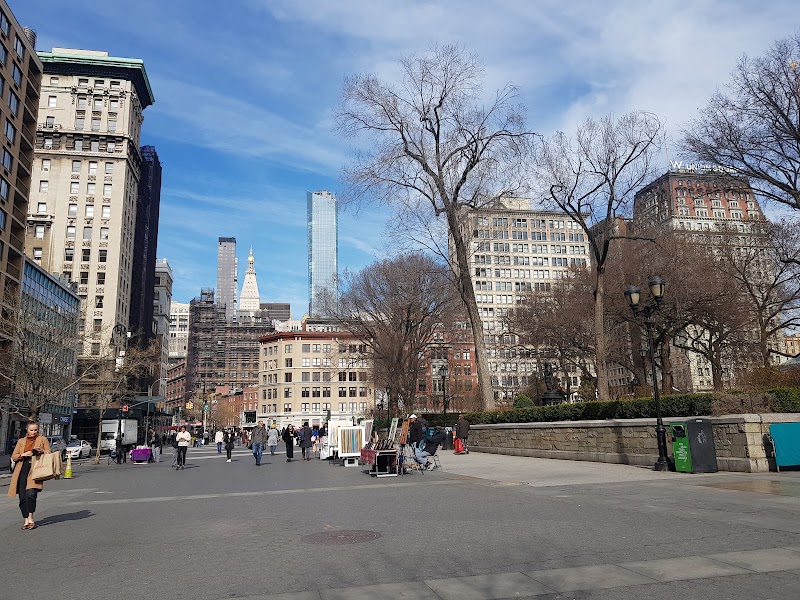
Union Square is not a beauty spot and does not try to be. It is a hard-working urban square with a green center: paved plazas at each end for crowds, market stalls and performers, and a planted core with lawns, mature trees and monuments. The 1932 pavilion anchors the north end, and the playgrounds and dog run sit behind it.
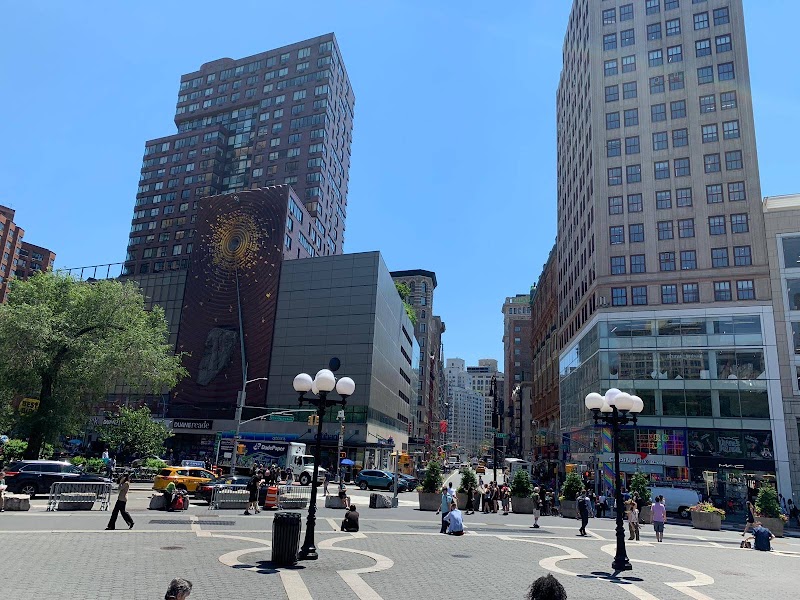
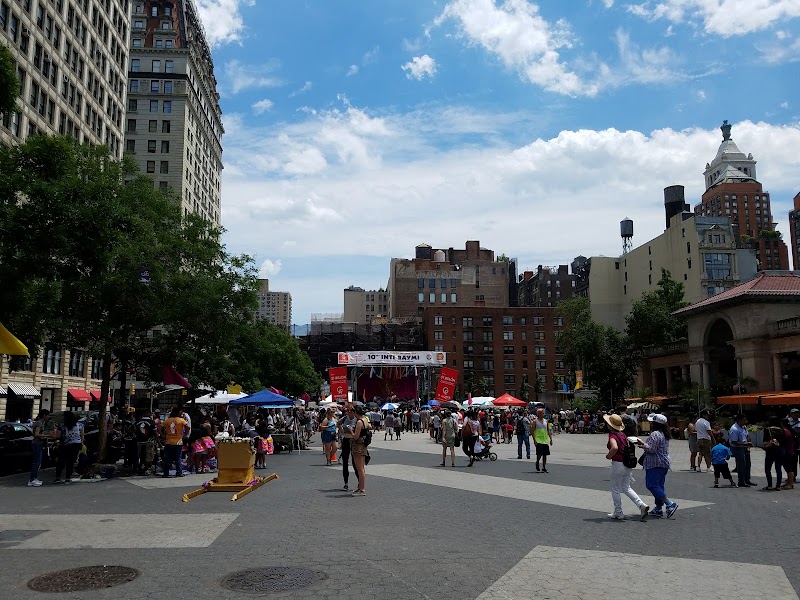
- The broad southern plaza — the market’s main floor, the protest floor, the skateboarders’ floor and the place buskers and chess players set up.
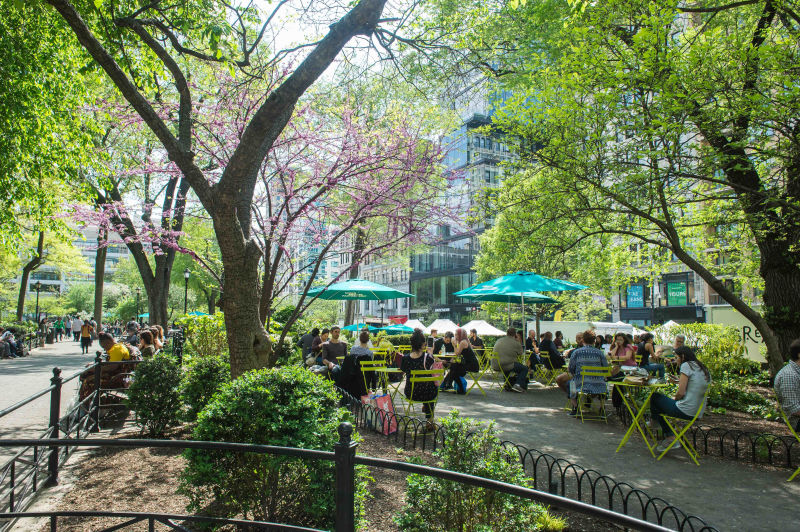
- The central lawns and shaded seating under mature trees, fenced and rested in rotation.
- The pavilion at the northern end, built in 1932, with a seasonal restaurant terrace below it.
- Two playgrounds, rebuilt in the mid-1990s, and a fenced dog run.
- Four major monuments plus the Independence Flagstaff, all within a two-minute walk of one another.
- Public restrooms, dense bench seating, and one of the busiest subway entrances in the system feeding straight into the square.
Things to do — and who it’s for
- Cooks and food travelers — the Greenmarket is a genuine working market, not a tourist showpiece: seasonal produce, cheese, bread, cider, fish and cut flowers straight from regional producers on four days of every week, year-round.
- Anyone who reads American history — labor history, Civil War history and monument history are all legible here, and the square was designated a National Historic Landmark in 1997 precisely for its role in the American labor movement.
- Students and remote workers — benches, shade, food within reach and a subway hub underneath make this the most practical open-air waiting room in the neighborhood.
- Families — two playgrounds, level paths, and a market that keeps children interested; the winter holiday market is a straightforward outing for all ages.
- Street-culture watchers — chess games, skateboarding, breakdancers, freestyle rap cyphers and performers work the plazas almost every dry afternoon.
- Shoppers — the square is ringed by major retail and bookshops, so the park doubles as the natural meeting point for a shopping day.
Getting there & practical
Union Square sits at the junction of the Flatiron District, Greenwich Village, the East Village and Gramercy, and it is one of the easiest places to reach in the city. The 4, 5 and 6, the N, Q, R and W, and the L all serve the Fourteenth Street–Union Square station directly beneath the square, which is among the busiest in the entire subway system. PATH trains from New Jersey stop nearby at Fourteenth Street. Numerous bus routes and Citi Bike docks ring the park. Entry is free at all times, including for the Greenmarket, which charges nothing to browse. The park opens at six in the morning and closes around midnight; the Greenmarket runs on Mondays, Wednesdays, Fridays and Saturdays from morning until early evening, and the holiday market takes over the southern plaza from late November until Christmas Eve. Half an hour is enough for the monuments; give the market an hour if you intend to actually shop. Paths are level and accessible, and public restrooms are on site.
When to visit
Spring is when the Greenmarket wakes up — ramps, asparagus and rhubarb arrive, the flowering trees come out, and the square fills with people who have decided winter is over. Summer brings the fullest market tables and the most street performance, though midday can be hot and hard on the paving; mornings are the civilized hours. Autumn is the market’s peak by a wide margin: apples, cider, squash, mushrooms and the last tomatoes overlap for several weeks, and the light in the square is at its best. Winter thins the stalls but never stops them — the Greenmarket runs through the cold months with root vegetables, storage apples, cheese, bread and meat — and from late November the holiday market fills the southern plaza with well over a hundred stalls, which is the busiest the square gets all year.
Good to know
The name has nothing to do with the Union of the Civil War, though the square earned that association later. It comes from the union of two roads — Broadway and the old Bowery Road — which met here at an awkward angle. The Commissioners’ Plan of 1811 set the space aside rather than force buildings onto the sliver, it became a public common in 1815 as Union Place, and in 1831 the developer Samuel B. Ruggles pushed through the enlargement and the renaming that produced the rectangle opened to the public in 1839. Within a generation it was the city’s great stage. On April 20, 1861, days after Fort Sumter fell, a crowd estimated at up to a quarter of a million filled the square in support of the Union — believed to be the largest public gathering in North America up to that time — and Major Robert Anderson appeared with the flag he had surrendered at the fort. On September 5, 1882, at least ten thousand workers paraded to Union Square in the demonstration now remembered as the first Labor Day. Emma Goldman spoke here; the square carried the great May Day rallies, the Sacco and Vanzetti protests of 1927, the mass unemployment demonstration of March 6, 1930 and the department store strikes of 1934. That record is why Union Square was designated a National Historic Landmark in 1997. The park was rebuilt more than once — the subway construction of the 1920s and 1930s forced a redesign that produced the 1932 pavilion, and the 1980s and 1990s brought a restoration, new playgrounds in 1993 and 1994, and the return of a neighborhood that had largely written the square off. The Greenmarket, started in 1976 as an experiment to give regional farmers a city outlet, turned out to be the single most successful thing ever done here. And in September 2001 the square became the city’s spontaneous memorial, covered for weeks in candles, flowers and missing-person flyers — the same instinct that filled it in 1861, still working.
Visitor tips
- Come on a Greenmarket day — Monday, Wednesday, Friday or Saturday. Saturday is the biggest and the most crowded; Wednesday gives you the same growers with room to move.
- Shop the market early for selection and late for the best of what is left; bring a bag, and remember that many stalls are cash-friendly but the market is not a supermarket, so what is there is what is in season.
- Walk the monuments as a loop rather than hunting them one by one — Washington, Lincoln, Lafayette, Gandhi and the Independence Flagstaff are all within a few minutes of each other, and reading them in sequence tells you what the square has been for.
Questions & answers
Is Union Square Park free? Yes. The park and the Greenmarket are free to enter and browse; you only pay if you buy from a stall.
Which days does the Greenmarket run? Mondays, Wednesdays, Fridays and Saturdays, year-round, from morning until early evening. It has operated continuously since 1976 and does not shut down for winter.
Is the square named after the Union in the Civil War? No. The name comes from the union of two roads, Broadway and the old Bowery Road, which met here at an angle; the space was called Union Place from 1815. The Civil War association came later, above all from the enormous pro-Union rally of April 1861.
What is the first Labor Day connection? On September 5, 1882, at least ten thousand workers paraded to Union Square in what is remembered as the first Labor Day demonstration in the United States. The square’s long labor history is why it became a National Historic Landmark in 1997.
Who made the statues? Henry Kirke Brown made both the equestrian Washington of 1856 and the Lincoln of 1870; Frédéric Auguste Bartholdi, later the sculptor of the Statue of Liberty, made the Lafayette given by New York’s French community in 1876; Kantilal B. Patel made the Gandhi dedicated in 1986; and Anthony de Francisci modeled the bronze base of the Independence Flagstaff, dedicated in 1926.
What is the clock with the steam on the south side? The Metronome, an installation by Kristin Jones and Andrew Ginzel from 1999, with a digital counter and a steam vent. In 2020 the counter was reprogrammed to run as a climate clock.
Is it a good park with children? Yes, with the caveat that this is a busy urban square rather than a quiet garden. There are two playgrounds rebuilt in the mid-1990s, level paths, restrooms and food all around; the market itself usually holds children’s attention well.
How long do I need here? Half an hour covers the monuments and a walk-through. Allow an hour on a market day, and more in late November and December, when the holiday market fills the southern plaza.
Photos
Show 1 more photos
Visitor reviews
Reviews last updated: 2026-08-04 20:06:35
Data is refreshed monthly. Sources: new-york.name and editorial picks based on reviews.
Such a lovely center of New York with its farmers market, artsy atmosphere, a place where you can sit, enjoy lunch, coffee or take a break from the day. A nice dog run, nice trees and flower beds. (The photos aren't mine…
• My favorite place during my trip to New York!
• Tons of restaurants and great cafés surround this park.
• The park is also well maintained.
• In the morning there's also a farmers market with fresh produce!
I passed through this park on my way to the Stonewall National Monument and found it a wonderful place for a walk, given the many other offerings common in Manhattan. This park's central location, along with the statues…
Union Square Park ist zwar eher ein kleiner Park, aber trotzdem einer der lebendigsten Orte in Manhattan. Mitten zwischen den Hochhäusern herrscht dort den ganzen Tag eine besondere Stimmung mit Straßenmusikern, Künstler…
A cozy, cute little park in the middle of the city.